
Why Human-Led Content Moderation Still Matters in the Age of AI

AI tools are fast and powerful but they still miss things that any skilled human reviewer would catch. Here is why expert human auditors remain the most important part of any content moderation strategy.
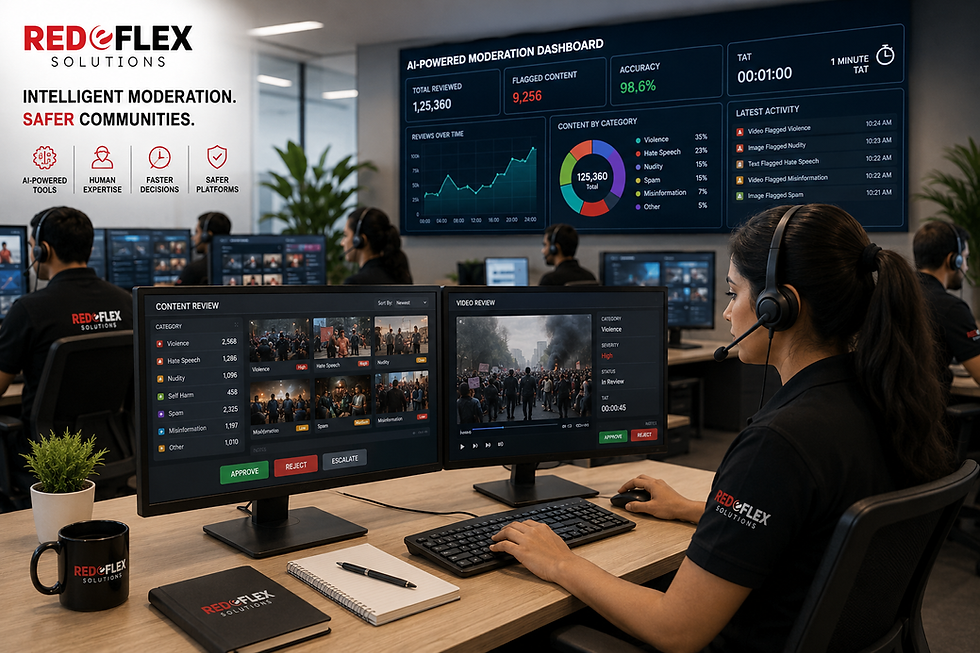
What AI is good at and where it falls short
AI moderation tools are excellent at repetitive, high-volume tasks. They can scan millions of images per hour, flag known hate symbols, detect nudity, and match content against banned keyword lists. For these clear-cut cases, AI saves enormous time and cost. But content on the internet is rarely black and white. When a post uses sarcasm, irony, coded slang, or a cultural reference from a specific region, AI systems frequently get it wrong removing innocent content or, worse, allowing harmful content to slip through.
38%
AI false positive rate on satire & sarcasm
4,800+
Expert human auditors at Redeflex
100%
Human + AI reviewed content
The challenge of sensitive and multilingual content
The internet is not written in one language or shaped by one culture. A phrase that is a harmless joke in one country can be a serious slur in another. A hand gesture that means "good job" in Europe may be deeply offensive in parts of Asia or the Middle East. AI models are trained mostly on English-language data, which means they perform poorly on content in Hindi, Arabic, Swahili, Tagalog, and hundreds of other languages spoken by billions of internet users. Human reviewers with the right regional background do not just translate they understand. That is a skill no model has fully replicated.
The false positive problem and why it matters
A false positive is when a moderation system removes content that should have been allowed. This is a bigger problem than most platforms admit. False positives frustrate creators, damage trust, and can even expose platforms to legal claims of unfair censorship. Research consistently shows that AI tools have much higher false positive rates than trained human reviewers, especially for satire, political commentary, art, news reporting, and health-related content. Every wrongly removed post costs user trust and trust is very hard to rebuild once it is lost.
Real-world moderation challenges AI cannot solve alone
Sarcasm and irony:
"Oh great, another politician stealing money" looks like a political attack to an AI, but is clearly sarcasm to any human reader
Misinformation:
Detecting false health or political claims requires fact-checking ability and real-world knowledge, not just pattern matching
Visual context:
A violent image in a news report is acceptable; the same image posted as entertainment is not only a human reviewer can make that call
Evolving slang:
Harmful communities constantly invent new coded words to bypass keyword filters; human reviewers who follow these communities catch the new terms first
Legal nuance:
What is legal in one country may be illegal in another AI has no jurisdiction awareness without constant manual updating
The hybrid moderation model the best of both worlds
The smartest approach is not AI or humans it is AI and humans working together. At Redeflex, AI tools handle the first pass: they scan content quickly, flag high-risk items, and filter out obvious violations. This means human reviewers spend their time on the cases that actually need human judgment the nuanced, sensitive, and culturally complex content that determines whether a platform is truly safe or not. This hybrid model delivers both the speed of AI and the accuracy of expert human review. It reduces false positives, improves cultural accuracy, and catches the harmful content that automated tools alone would miss.
AI reads words. Humans understand meaning. That difference is everything when the safety of real people is at stake.
Why expert auditors are a long-term investment, not a cost
Platforms that rely entirely on AI moderation save money in the short term but pay a much higher price later in user complaints, advertiser pullouts, regulatory fines, and reputation damage. Trained human auditors who understand your platform's values, your audience's culture, and your compliance requirements are the strongest defence against content-related brand risk. Redeflex's 4,800+ qualified auditors are not just reviewers they are the trusted layer of judgment that keeps platforms safe, fair, and credible for their users.
Conclusion
As digital platforms continue to grow, maintaining safe and trustworthy online spaces requires more than automation alone. Human-led moderation adds contextual understanding, emotional intelligence, and cultural awareness that AI cannot fully replicate. By combining advanced technology with experienced auditors, Redeflex Solutions Pvt. Ltd. helps businesses deliver safer digital experiences while protecting brand reputation and user trust.


Comments